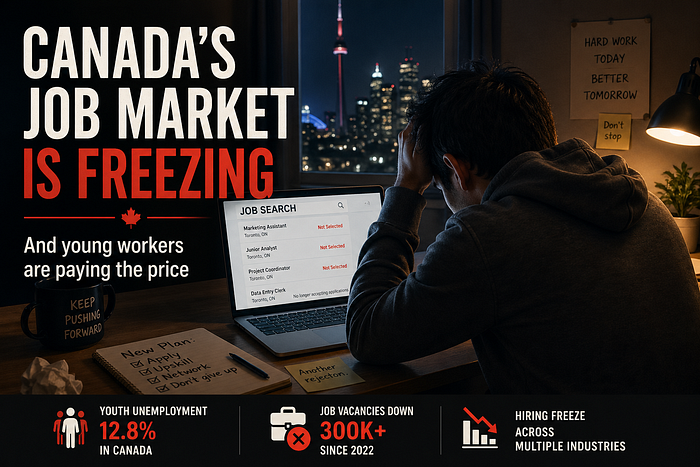

There's a quiet shift underway in the Canada job market slowdown, and it doesn't behave like a normal crisis. No mass layoffs. No panic on the evening news. Still, something is tightening beneath the surface.
Hiring hasn't collapsed. It has stalled.
Look closer and the numbers start to move in a different direction. Job vacancies have fallen from over one million in 2022 to roughly seven hundred thousand by 2025. That is not a crash. It feels more like a slow withdrawal.
The kind you only notice when you keep knocking and nothing opens.
The Freeze You Don't See Until You Feel It
On paper, the economy looks stable. Inflation has cooled. Growth hasn't disappeared. Policymakers managed to avoid a sharp downturn.
But businesses have shifted into caution.
Higher borrowing costs changed the mood. Expansion plans were trimmed. Hiring, quietly, was the first thing to go. Not layoffs. Just a kind of silence that stretches longer than expected.
I thought this might be temporary at first. Maybe it still is. But the pattern is getting harder to ignore.
From a distance, it looks like balance. Up close, it feels like a system that pauses when you try to enter it.
A Generation Stuck Before It Even Starts
The pressure lands hardest on young people.
Youth unemployment sits around 12.8%. That number matters, but it only tells part of the story. The rest shows up in smaller moments.
A graduate in Toronto, trained in data analytics, spends months applying for entry-level roles. He ends up working part-time at a grocery store, just to keep things moving. Six months pass. Then nine. At some point, the degree starts to feel less like an advantage and more like a question mark.
I have heard versions of this more than once. Different cities. Same pattern.
The shift is subtle but important. Entry-level jobs are still listed, but expectations have changed. Employers want people who are already trained, already useful from day one.
The ladder is still there, but the first rung is missing, and people are left figuring it out on their own.
Survival Work Becomes the Default
What replaces stability is not unemployment. It is fragmentation.
Contract roles. Gig work. Part-time shifts that don't quite add up to a career.
Flexibility sounds modern. In practice, it often means uncertainty.
Without predictable income, planning becomes difficult. Saving becomes rare. In cities like Toronto or Vancouver, where housing costs stay high, people adjust their expectations quietly.
Not failing. Not moving forward either.
You start to notice it in small habits. Scrolling job portals late at night. Refreshing the same listings. Seeing the same roles posted again and again.
That middle space, somewhere between employed and secure, is where the slowdown is doing its real work.
Why This Is Happening Now
Several forces are moving at once.
Population growth has accelerated. Immigration has brought in talent and energy, but job creation has not kept pace. That increases competition, especially at the entry level.
Technology is shifting the ground as well. AI tools are absorbing routine tasks. Not fully replacing people, not yet. But reducing the number of openings just enough to matter.
At the same time, companies are choosing efficiency over expansion. Hiring decisions are delayed. Signals are unclear. So they wait.
There is another detail that stands out. Youth unemployment in Canada is now noticeably higher than in the United States, where it sits closer to eight percent. That gap suggests something more than a global slowdown.
It points to a structural shift taking shape.
A Reset, Not a Cycle
This may not pass quickly.
After the 2008 financial crisis, many young workers entered weak job markets and never fully caught up. Their earnings lagged for years.
This time feels different. The pressures are layered. Technology, housing costs, population growth, and corporate caution are all moving together.
That combination doesn't just slow things down. It reshapes expectations.
If early careers begin in instability, the effects stay. Delayed independence. Lower savings. Fewer risks taken later.
The system does not break. It bends. Quietly, and over time, in ways people don't always notice at first.
What Happens When a Crisis Stays Quiet
The problem with the Canada job market slowdown is not just its impact. It is how easy it is to overlook.
There is no single moment that forces action. No sharp shock that demands a response. Just a slow build-up of missed chances.
Policy may adjust. Businesses may recalibrate. Education systems may shift.
But those changes take time.
In the meantime, people adapt. They take what is available. They move sideways instead of upward. Some make it work. Others wait longer than they expected to.
And maybe that is the real shift.
Not a collapse. Not even a clear downturn. Just a gradual change in what a "normal" career looks like.
So here is the question that stays with me.
If this is not a crisis loud enough to fix, but real enough to shape a generation, what kind of workforce is Canada quietly building?