
My first encounter with Middle Earth was when I came across The Hobbit in my first year of high school. The Hobbit gave me the same sense of the numinous and of "northerness" as earlier had C.S. Lewis's Chronicles of Narnia. I had borrowed it from the local library, did not remember the name of the author and only several years later as a teenager did I discover the Lord of the Rings (LOTR). It was originally published in three volumes in 1954 and 1955, 18 years after the Hobbit was published in 1937. The Lord of the Rings became immensely popular in the 1960s with the publication of the Ballantine paperback editions, and in North America, the publication of the Ace pirated edition. I first read it in 1969, when I purchased the 1968 first edition of the George Allen and Unwin one volume paperback with cover illustrations by Pauline Baynes:
But LOTR is in a different class to the Hobbit. Without the Hobbit's narrative tone of telling a tale to children, it describes an epic struggle of good and evil in a fully realized world, with a depth of history, mythology, poetry, beings and languages that was unparalleled in any previous fantasy literature. Despite some literary critics turning their noses up at fantasy, it was greeted with acclaim by others and now has a substantial body of critical and academic work. LOTR is ranked among the greatest books of the twentieth century or of all time in a number of lists (see for example here or here), and its popularity has been boosted among new generations by the Peter Jackson trilogy of LOTR movies.
I loved LOTR so much that I must have read it somewhere between 10 and 15 times in the years after I first read it. While I collected a number of editions of LOTR and The Hobbit, in English, French and German, I almost always read the one volume paperback I'd bought in 1968. Its now almost falling to bits (see photo below). It did not include the Appendices, and when I went to Sydney University in 1971, I photocopied the Appendices from the three volume edition I found in the Fisher Library and immersed myself in the study of all things relating to Middle Earth. During my University days, I was a keen bushwalker, rock-climber and canyoner, and many is the wilderness campfire around which friends and I discussed LOTR and Middle Earth. Among many other things, the LOTR is the story of one of the greatest long distance wilderness walks on record!
I kept a record of the first 8 times I read it, and I had read it 6 time in the three year period 1969–1972. After several readings, I decided to read it slowly and savour the writing, the details, the poetry. But after I got about halfway through, the momentum of the tale swept me up and I speed-read the rest of it. In December 1972, I decided to record how long it took me to read the LOTR. I kept a record of reading times in the back of the paperback, and consulting it now, I see that it took me 21 hours and 20 minutes. As LOTR is 481,103 words long, that is an average reading speed of 376 words per minute.
I joined the UK-based Tolkien Society and collected a fairly comprehensive library of works by and about Tolkien and Middle Earth. For a few years, I think I had a fairly complete set of published academic papers relating to Middle Earth, and did my own research among the medieval and earlier literature of Britain and northern Europe, sources of much of Tolkien's mythological themes, names, languages, etc.
One of the things that appeals to me most about the LOTR is how it conveys the reality of Middle Earth and its immense history through glimpses of a coherent and much more expansive world, both in time and space, than is actually experienced in the narrative of LOTR itself. And that more expansive world has workable languages (that can actually be learnt and spoken) that are aesthetically pleasing, and complex political/social organizations and various different sentient species with their own detailed cultures and characteristics.
It also includes an expansive geography populated by forests, marshes and mountains which play a key role in the narrative but also clearly extend beyond the playing field of the narrative. This is rarely seen in other works of science fiction or fantasy, where names and languages are made up randomly and give no sense of belonging to a coherent culture or actual language, and where there is often little development of place and history beyond that needed for the story.
Of course, the reason LOTR is so successful in the creation of the world of Middle Earth is that Tolkien actually spent many years working on the languages, history, geography and mythology of Middle Earth before writing The Hobbit and later LOTR. And as a professional philologist specializing in the literature of early Britain, Tolkien was uniquely placed to do this. Tolkien was quite critical of his friend C.S. Lewis's Narnia books, because Lewis mixed features from different mythological backgrounds. Greek fauns lived in Narnia along with Northern giants and trolls.
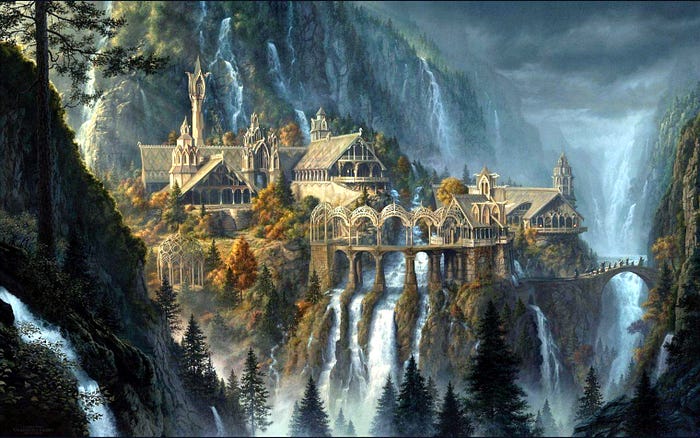
Tolkien has made clear in some of his letters and other writing that his main intention with the creation of Middle Earth and its narratives was to develop a mythology native to England separate from the mythologies of surrounding cultures. He felt that England lacked such stories bound up with its languages and landscape, such as found in Celtic, Romance, Germanic, Scandinavian and Finnish mythologies. He explained this in his letter #131 (in The Letters of J.R.R. Tolkien), going on to say that the Arthurian world was powerful but imperfectly naturalized. Its "faerie" was too lavish, fantastic, incoherent, and repetitive. More importantly, it involved and explicitly contained the Christian religion. That seemed fatal to Tolkien. Myth and fairy-story must reflect and contain parts of moral and religious truth or error, but not explicitly as in the real world.
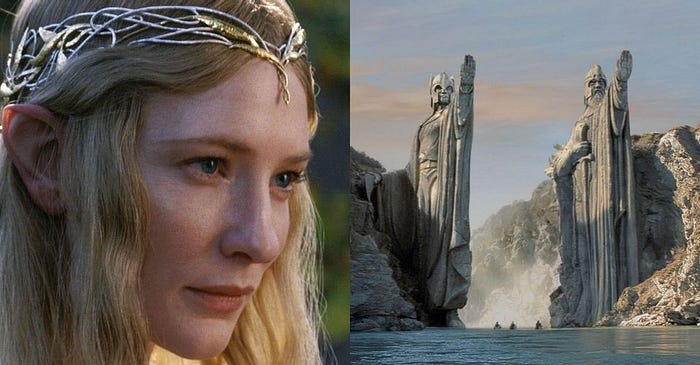
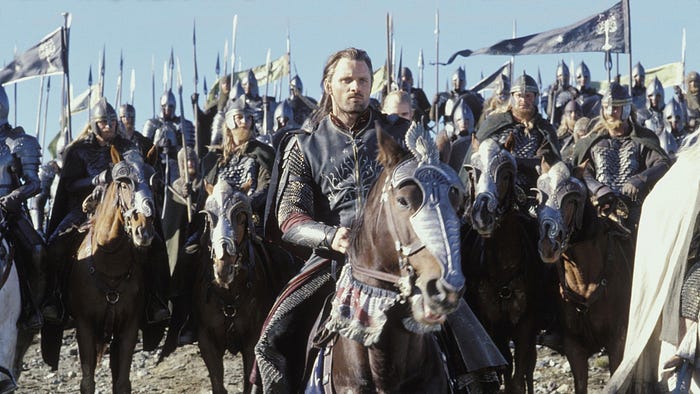
When the Peter Jackson movie trilogy came out in 2001 to 2003, I loved them and have also watched them several times. Jackson made a lot of effort to be faithful to the world depicted in Middle Earth, with a lot of attention to detail and landscape. Although aspects of the story were modified and to a certain extent departed from the intent of Tolkien, the world depicted largely meshed with my imagined Middle Earth and there were few outright clashes. In particular, Jackson's imagining of the various races, Elves, dwarves, Numenoreans, orcs, and various monsters, was inspired as were his casting choices for most of the principal characters, particularly Frodo, Sam, Gandalf, Elrond, Aragorn, Faramir and Eomer. Their faces are the ones I see now when I think of the characters, and the Elves of the movies are what I see when I think of the Elves of Middle Earth. Though I don't think he really succeeded with his depiction of the Ents.
I try to ignore the unfortunate "Hollywood" moments that crept in, such as when Legolas runs up the side of the Oliphaunt and does gymnastics in the air around it. Fortunately, there was not too much of that. The same can't be said of the Hobbit trilogy which was substantially spoilt by ridiculous action scenes, including a roller coaster ride inside Moria which would have been over the top for Indiana Jones.
After I last read LOTR some time in the 1980s, I did not read it again until relatively recently. I did purchase and read The Silmarillion and quite a number of the books in The History of Middle-earth series, compiled and edited by Christopher Tolkien in the 1980s and 1990s. These included much of the unpublished writings of Tolkien on other tales of Middle Earth and on the evolution of the history of Middle Earth over the course of Tolkien's writings.
I was looking at my Tolkien bookcase a few years ago and realized I had never read the de luxe one volume edition that I bought in 1972. So I decided to do that, and to look more closely at elements that were left out of or distorted in the movies.
The one volume De Luxe edition of The Lord of the Rings was published in 1969 by George Allen and Unwin on India Paper with a black slipcase. The cover is black buckram cloth and has Tolkien's design depicting the Numenorean throne with 'Elendil' in tengwar, stamped on it in gilt, silver and green. As I was reading it I quite often had to struggle to turn the page, as the paper was so thin that I usually picked up two pages together. In the one inch thick volume are included two large foldout maps of Middle Earth shown in the photos below. Only the 1st and 2nd impressions were issued with a slipcase, and I have the 2nd impression, printed in 1972. My copy is as-new, it sat on my bookshelf protected in its slipcase for 49 years until I took it out to read it.
I completed the three volumes in one week, reading it mostly in the evening for a hour or few. As usual, my reading sped up as I got further into it. I thoroughly enjoyed reading it, and came across many passages that I had lost all memory of, I think replaced by the memory of the movie version. Of course, I knew that there were some major episodes such as the visit to Tom Bombadil in the Old Forest that were completely omitted from the movies, but there were many other episodes where I realized the movies had made substantial changes.
I give just one example. In the third movie, Aragorn demands that the spirits of the dead oath-breakers come with him to fulfil their oath, and they arrive outside the walls of Minas Tirith as battle rages with the armies of Sauron. The dead rout the enemy from the battlefield, so that Gondor wins the Battle of the Pelennor Fields, and are released from their oath. In the book, Aragorn uses the army of the dead only to win the Corsair ships from mercenaries and pirates chiefly through fear, before Aragorn frees them, sailing upriver to Minas Tirith with Legolas, Gimli, the Dunedain and some Gondorian forces.
Apart from plot lines, two other aspects of the book struck me in this re-reading. Firstly, the beauty and power of Tolkien's writing, and the wide range of styles he used with good effect. From a homely, humorous style when concerned with hobbits, to lyrical word portraits of landscapes, to high saga when concerned with the deeds of the great, and sprinkled liberally with songs and poems in many styles. While I had remembered many of the poems in LOTR, and indeed can still recite some from memory, there were many more that I had not remembered from my earlier readings, and this time I did slow down and savour them.
Secondly, there were many details of information about Middle Earth and its history and inhabitants than I had remembered, and some I don't recall reading before. For example, when the Hobbits meet Tom Bombadil and ask him who he is, he describes himself as the Eldest, "here before the river and the trees", before the Elves and the other races. But later in the book, after Merry and Pippin meet Treebeard, Gandalf describes Treebeard as "the oldest of the Ents, the oldest living thing that still walks beneath the Sun upon this Middle-Earth". There are many theories as to the nature of Tom Bombadil (see for example here), but the apparent contradiction is resolved when we realize that Treebeard is a living thing (the Ents were created at the same time as the dwarves) whereas Tom Bombadil is likely a spirit, not a living thing. In my view, Tolkien included Tom as an archaic nature spirit rather like the English Puck, a mystery who does not fit within the hierarchy of spirits and beings of Middle Earth (Eru Iluvatar, Valar, Maia, etc).
So what of Middle Earth now that I have revisited it more than 50 years later? I enjoyed LOTR as much as the first time I read it and my appreciation of Tolkien's skill as a writer and the brilliance of his creation has deepened. I feel that Tolkien largely succeeded in his quest to create a mythology for the English. And my only caveat would be that he left the job unfinished, with a large volume of partly written legends and history that are not fully consistent, and have now been published in huge detail by his son Christopher Tolkien, creating confusion more than clarity with various succeeding iterations and evolutions of the opus all being explained in enormous detail.
I followed up that reading by re-reading The Silmarillion for the second time and finally getting around to purchasing the Extended Edition of the Lord of the Rings movies. I planned to watch the three extended movies (a little more than 12 hours of viewing) in one extended session. But somehow the time was never right. I finally watched them last year (2025) one movie per night, followed that by watching the three sets of supplementary documentary material on their making, one per night.
I was initially somewhat sceptical of the added value of the additional material in the movies, but the supplementary material gave me a substantially expanded appreciation. Now, I will certainly pull out the Extended Editions when I again want to watch the movies. While some long-term Tolkien fans look down on the LOTR movies for the changes they made to Tolkien's story, I can appreciate their separate pleasures and have a better understanding of the differences and the reasons for them. I no longer have a Jackson overlay on my memory of the real story, but that exists as a separate set of memories with their own artistry.
The LOTR is the perfect story for the current crisis that besets a world which is increasingly declining into autocracy and war. Set in a world of epic heroes and villains but focusing on the ordinary folk, the hobbits, who aren't made for adventure, but when it comes down to it, do the right thing and persevere with no real hope of success. They just keep going, because they understand that there's good in this world worth fighting for. Frodo teaches us about endurance and compassion, because it is ultimately his compassion (and at a key point, Sam's also) which spares Gollum and that ultimately saves the world.
Like the hobbits, we are dealing with crises that are upending our lives, and we wish they had never happened. But as Gandalf says, "So do all who live to see such time, but that is not for us to decide. All we have to decide is what to do with the time that is given to us."
This is an update of an earlier article published at http://mountainsrivers.com on January 23, 2021.
A second article on the chronology of Middle Earth can be found on Medium here.