

Diagnosis
Forcing down a sob, I squeaked, "Is there a private room where I can make a phone call?" The receptionist in the surgery waiting room at Philadelphia's Jefferson Hospital met my eyes with knowing sympathy and gestured to a room to the right where I could call our kids, Emma and Ethan, to tell them their mom was probably going to die.
Dr. Malley had just come from surgery in January 2024 to deliver his diagnosis of Debra's holiday gallbladder pain. His manner was kind yet direct. The cancer he removed was about as far advanced as it could be before surgery would have been too futile to inflict upon her. According to the American Cancer Society, she faced less than a 1-in-3 chance of surviving 5 years.
In a follow up visit, his life advice to her was simple. Go out and live life to its fullest. And if the cancer is beaten, then the only downside is you've had a great time. We finagled our finances and by September I ditched desk life as an interactive designer. Librarian Debra holstered her shushing finger for the last time. We snuck off to Vienna to gleefully wallow about in the works of Egon Schiele and Gutav Klimt, our favorite degenerate artists from the early 20th century.
A year past surgery, Debra's cancer was becoming a memory and a cautious hope began to rise in us. I felt the need to burn the last of my office-casual and go roam wild America as an artist. I would record elusive flora and fauna, sketchbook in hand, and interview odd humanity. I imagined crafting my raw materials into colorful hand-hewn linocut prints upon my return. "Why yes, it was quite an adventure!" I would later confide with satisfaction to my enthralled gallery patrons, spilling wine down my front as I emoted.
I applied for nearly a dozen artist residencies with the national parks. Various organizations offer housing for artists to work at their lovely locations for a few weeks or even months in exchange for a piece of art. Plein air painters — artists who paint landscapes on location — are a favorite choice. Unfortunately, I don't do a lot of that.
Rejections plopped into my inbox over the following months, and it was just as well. Life came at us hard over the spring with both good and bad. We bought my childhood home in Delaware from my siblings. We owned two rental properties in Pennsylvania that needed work. I also lead an arts nonprofit.
But overshadowing everything were a series of ominous test results, building up to a CT scan on July 17, suggesting Debra's gallbladder cancer was back with a tumor as wide as a credit card near her pancreas. A tumor that appeared so suddenly and grew so quickly, Dr. Pallavi Rastogi, Debra's oncologist at Paoli Hospital, shook her head in disbelief.
My love of 30 years would need chemo again after surgery on a related hernia. She would need a permanent port inserted by her collarbone to pump toxic drugs into her body. The future became too bleak for my bride to even think of plans for our upcoming 30th anniversary without tears.
Then the following week, an email came from Visual Information Specialist Wesley Butler at Indiana Dunes National Park. "We are happy to announce that you have been selected to participate."
Well three shots of india ink for me! Sort of… Debra needed me. I was living a very different life when I applied for this. But Debra is also a passionate artist and she understands creative frustration better than anyone. We had some wiggle room on the start date in Indiana to fit it between surgery and chemo. Our adult son was living at home to help out. We found a way for this to work and she gave me her blessing.
Indiana Dunes National Park is the third youngest park in the U.S., having graduated from National Lakeshore to National Park in 2019. As I write this, only White Sands and New River Gorge were more recently upgraded to the varsity team.
This was a big leap for me and I didn't feel ready. I felt further away from success as I considered everything in the park that I wouldn't normally sketch. One could argue that I suffer from imposter syndrome. One could also argue that imposters are real.
But nothing focuses the mind like the prospect of a drawing, so I packed my Subaru and left for the Dunes on September 9 for a two-week stay. Within 2 months of my residency I would owe a finished piece of art to the park for their gallery.
I like to make drawings for Debra. And when I travel, I send them to her as postcards. But this time was different. As a husband, I can fix many things, but I can't fix cancer. Learning to accept that is crushing. But I can tell Debra that no matter what happens, I love her dearly and she will never go through this alone.
I think of her always in those focused moments with my pen, and sometimes shed a few tears. But please don't tell her I told you that. I like her to think she fell in love with a man from a proud line of emotionally stunted British people.
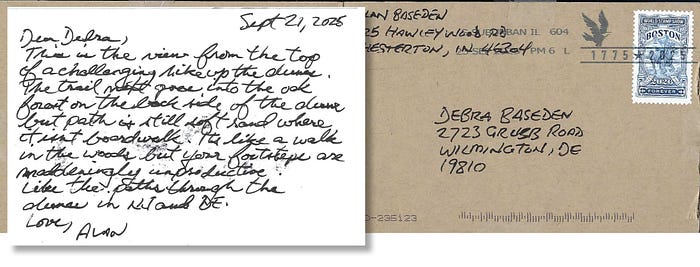
Sometimes I just write musings on the back, stamp them, and send them as postcards. Sometimes I make bigger ones that I fold over into letters. These are pieces of my heart — machine sorted, man handled, and postmarked.
The Drive
The neighborhood addicts who stuck guns in our faces. The enraged landlady who hurled a glass at my face (and fortunately missed). The stately Victorian house we rented for peanuts during Brooklyn's crack epidemic.
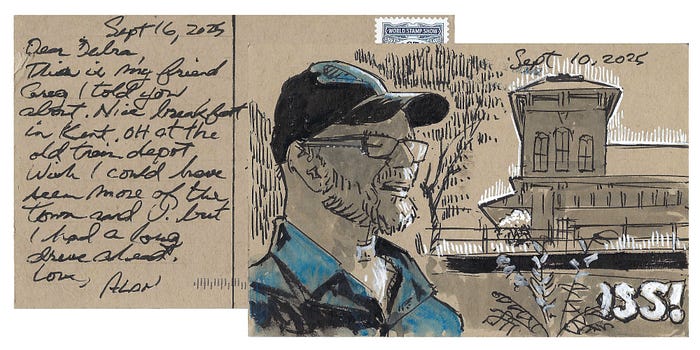
There are few people I can relate to about my days in art school like I can with Greg Lovinski, my junior-year housemate from Parsons School of Design. To my good fortune, his home in Kent, Ohio was the halfway point of a two-day drive between Wilmington and Indiana Dunes. I caught up with Greg for breakfast after a night at the nearby Quality Inn.
Greg chose Over Easy at the Depot for a bite and I knew it would be good. He's always been a culturally savvy guy whether it comes to films, art, or food. In this sketch, the place grandly fills the historic rail building behind him. As one does with any true friend, we slipped right back into the latest updates to conversations from decades ago. After I put in an order for eggs benedict, I laid a gift on the table that I was certain he would love. His familiar chuckle bubbled up in appreciation as he unwrapped the vintage 1980s printing of Watchmen. It was actually his book. I borrowed it 38 years ago and I still haven't read it.
Greg's late father was the Managing Editor of The Detroit News and my friend always spoke of him with pride. He often recommended writers to me such as Gore Vidal or P.J. O'Rourke. I knew I made a good career move when I took my first job working for the New York Times instead of some frou-frou design studio. It meant a lot to me to know I made a Greg-approved choice.
After a comfortably long breakfast we strolled over to the park on the other side of the river and he gamely stood for this sketch as we talked about our mutual appreciation for urban sketching, the news industry, family vacations, and everything else in the world.
Arrival
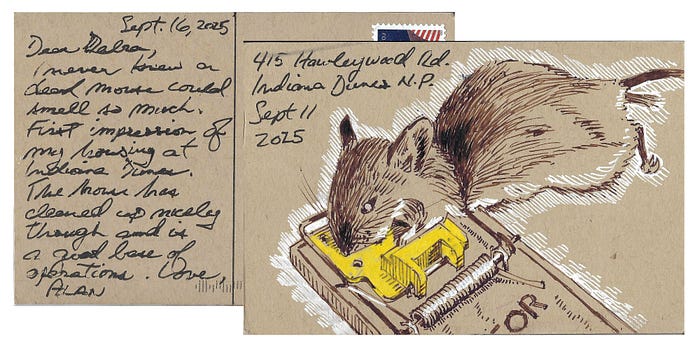
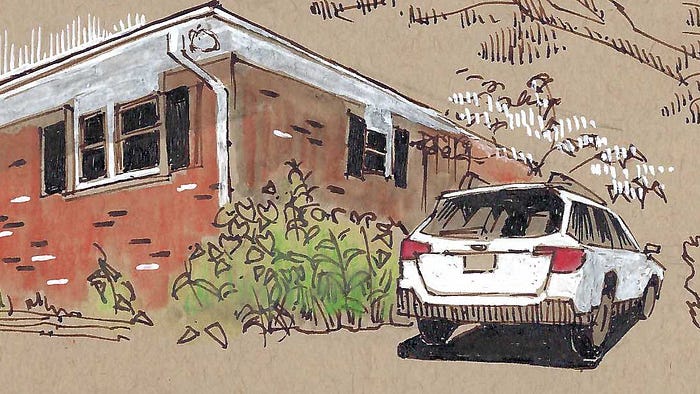
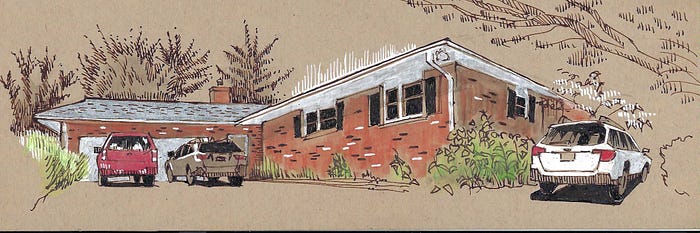
I cautiously stepped into the 3-bedroom, mid-century ranch house in the woods on September 11 and I was embraced by the swollen smell of rot in dark stagnant air. As I opened the windows and sprayed air freshener, I felt like Jonah in the guts of a whale trying to convince himself he was getting a good deal on the rent.
My base of operations, clad in local cream-colored limestone, hugged an edge of the park, 4 minutes from the Visitors Center. I am very grateful for the hospitality, kindness, and respect for my endeavors shown by my program lead, Wes Butler, and the rest of the park staff. So I feel quite rude having chosen this mouse as my only depiction of the place.
The smell filled every corner of the house equally and seemed to come from the house itself. Only after I removed this poor little executed creature from the kitchen floor did I realize it was entirely the culprit. It may have wafted out a whale's worth of stank, but I am fond of the sketch.
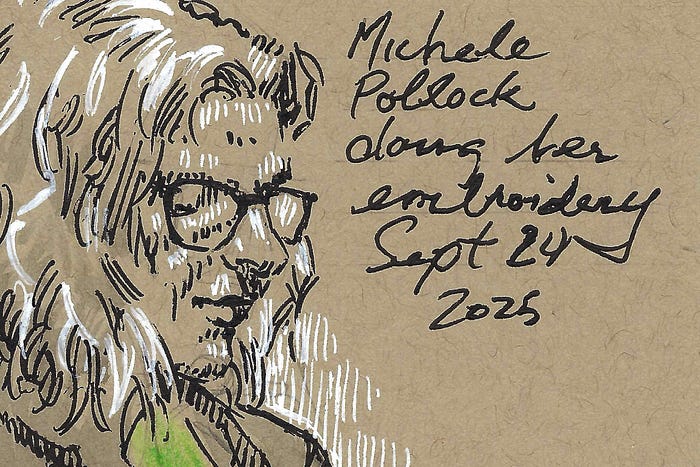
I would soon share the house with locally-grown Hoosier Michele Pollock. I was impressed in my first meeting with my co-artist-in-residence. She showed me sketches she had done of colorful rocks she found on the beaches on her first day. The lines, tones and textures were inspiring. On my final night I got Michele to sit for this sketch while she embroidered her final piece for the park. I would have felt weird sending this one as a postcard though, so I didn't. Like, "Dear Debra, here's the random woman I've been living with".
Debra
When Debra was a child, her father would sit her on his lap and "read" to her. My late father-in-law worked in a paper warehouse and spent a good deal of his youth in a Brooklyn reform school. He was thoroughly illiterate, but he would look at the pictures and tell her the story as best he could figure. She became a standout student and teachers in Queens took her under their wings, nurturing her intellect.
We met in New York City through a Village Voice personal ad I placed in March of 1993. I was a pony-tailed young artist working in the newsroom of the Associated Press and she was a fantastically talented illustrator working on children's wear prints in the garment district before becoming a librarian.
The way the ads worked was that you paid for a short print ad that had a code with it. You then called in and recorded a custom message, If someone was interested, they called the personals line and punched in the code. They would be greeted by your message. If interested, they could then leave their own message and cupid took over from there.
I actually had to re-record my message after I received a few responses. I was a former summer camp counselor with a love of sailing, windsurfing, and water skiing. In my recording I naively described myself as being "into watersports". If you aren't laughing at my expense right now, just google that from outside your workplace to see why that was a very poor way to describe my enthusiasms.
Fortunately Debra heard the second version. We met for a game of pool, and two years later we were married in a Delaware park with a reception in the backyard of the home we now own.
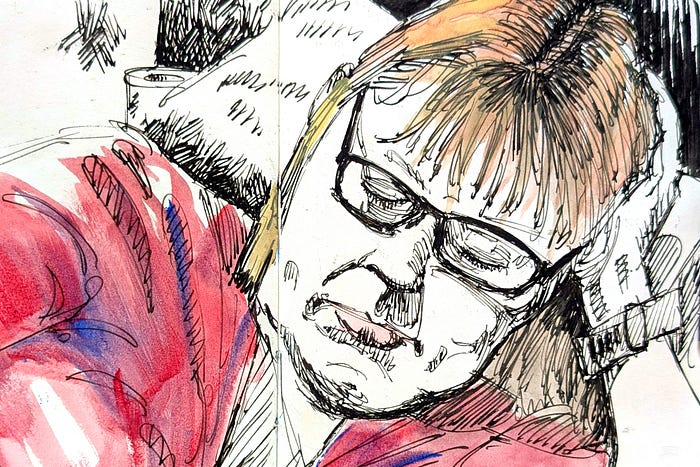
I sketched her one evening after work a few years ago. She was relaxing on the bed as she always did after a long day working at the library. By reading. I swear to you, she has read every book ever written.
Now, after leaving her library career behind to enjoy life, a cancer recurrence loomed. But we found a ray of hope. Or maybe just merciful denial. Dr. Rastogi had consulted with a colleague and had an update. There was a chance the worrisome growth might be something else entirely. She got her hernia surgery, and after a few weeks of recovery, I left for the dunes. She scheduled her follow up visit for September 18. Hopefully we would soon have answers about what was inside her.
Mount Baldy ate a child
I parked in the Mount Baldy lot and screwed on my tan baseball cap with a "volunteer" logo on it. Wes had given it to me to identify me to staff as someone who was entitled to free parking and a bit more liberty to roam. A friendly staffer who identified himself as Ranger Lark spotted the cap and struck up a conversation. He had a whimsical name, a blonde moustache, shaven head, and flowing arm tattoos. He checked passes, and also took payments, I presume. Chatting as he chain-vaped, he offered some interesting leads on places to see. Most of them didn't pan out unfortunately, but I did appreciate his interest. I mean, he said he was a ranger. Well if he wasn't, it was a good hustle.
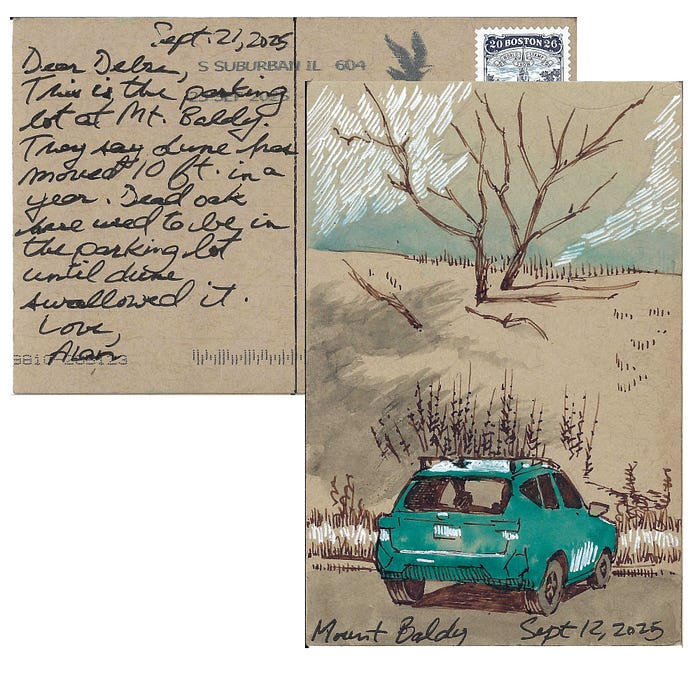
Muscling in on the parking lot was an arm of the giant "living" dune with dead oak trees sticking out. The sand has moved inland 10 feet in a year, swallowing them. Until recently, these oaks bordered the asphalt. In 2013, the sand also swallowed a child.
Six-year-old Nathan Woessner climbed onto the 126-foot Mount Baldy sand dune with family and friends and vanished. He was there one moment and then not. His family called his name and scoured the area with rising panic. They eventually found him crying out from a 10-ft deep hole. The more they dug to free him, the more the sand collapsed into the hole. After 3 and a half hours a team of 50 rescuers with construction excavators pulled the little guy out, cold and lifeless.
Investigators later found similar deep dangerous holes that had been unknown. They formed from dead oak trees smothered by movement of the dune. The oaks cast long holes as sand compacted in on them and then they decayed. Presumably, these oaks will become holes too.
Nathan was revived at the hospital and recovered fully. It's thought that he survived in an air pocket left by a tree trunk.
I moved on to the densely forested trail that flanks left of the dune's peak. After a short time, the trail became soft and sandy and a gap opened before me revealing the blue oceanic expanse of Lake Michigan. The forested oak lead-in was novel to me. In the mid-Atlantic, the ocean approaches slowly with flat sandy terrain and shrinking pines. The smell of salt water draws out memories of sand castles and body surfing. All of that was missing. Not in a bad way. It was just surprising. Like turning a corner in the Shenandoah Valley and stepping into Cape Henlopen.
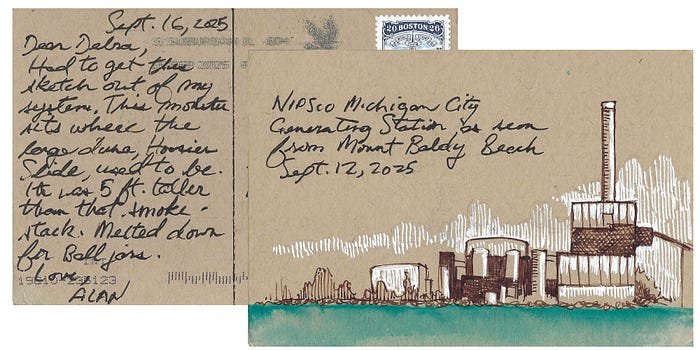
However, I only felt a sketch coming on when I reached the end of the trail, and the edge of the park, at the east side of Mount Baldy Beach. As I curated a drawing and a sunburn on a driftwood log, a friendly older couple from North Carolina strolled by to ask about my work. I showed them the drawing and explained the residency. They rightly looked confused as they glanced at beautiful Mount Baldy behind me and then looked back at my drawing of a power plant. I can see how it appeared to be a weird subject choice.
I chose to draw a spot where this beautiful land had been transformed by a cancer of its own. Twentieth century industry left it scarred and unwhole. This postcard is now the view where the largest dune in Indiana, Hoosier Slide, once dominated the beaches in the late 1800s.
The Ball Brothers, founders of today's Ball Corporation, discovered that its pristine iron-rich sands could be transformed into beautiful blue glass. The popular tourist destination, site of weddings, boxing matches, and fireworks displays, stood 200 feet high — taller than this smoke stack. By the 1920s it was excavated, shoveled into box cars, and melted into blue Ball jars. This power station now cauterizes the east end of the park — an abrupt scar where Hoosier Slide dune once stood.
Stick your pickle in that jar for a moment. I would come back to give Mount Baldy its artistic due another day.
Roaming wild America, sketchbook in hand
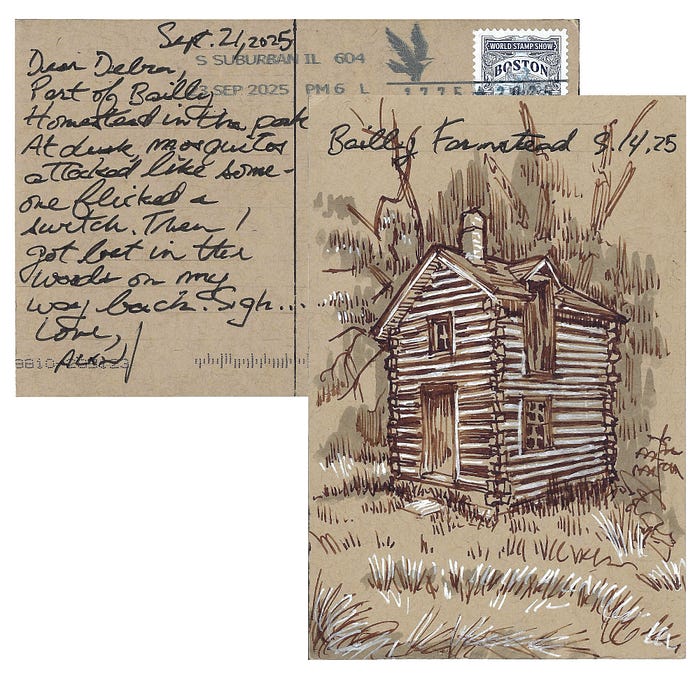
"What's that? A 2-story outhouse?" I blurted out to Wes when he took me on a tour of the park upon my arrival. I have a tendency to make wisecracks on occasion and I'm not sure it makes me a good guest.
I returned three days later to sketch this curious 12-ft square cabin, part of the Bailly Homestead. I had spent the day writing, reflecting, and caffeinating. Then reluctantly knocked out my physical therapy routine. Seeing how late it was getting I dashed back over to Bailly for a quick sketch.
After a solid 30 minutes of fountain pen time, the mosquitos let me know I was done. The little nasties were relentless at dusk. No amount of bug spray, garlic, or crucifixes could ward them off. I stuffed my supplies back into my canvas pack and hurried back in the direction I came.
The path seemed familiar. Then kind of not. I finally happened across a helpful signpost that showed me in the fading light how I was on the wrong path entirely. Flailing at mosquitos like a ten-year-old girl being chased by bees, I discerned a squiggling option to get me to a road. I ran down the path on my flat, misshapen, potato feet, not wanting to spend the night out there.
I finally came out in the back of Chellberg Farm. A fence and a sign warned lost artists to keep out. I trespassed my way through to the road anyway and reunited with my Subaru. The farm was part of the park, so I didn't think mean old man Chellberg was going to bust out in his overalls and plug me with a load of buckshot, but I've seen some things in my day.
Central Dunes
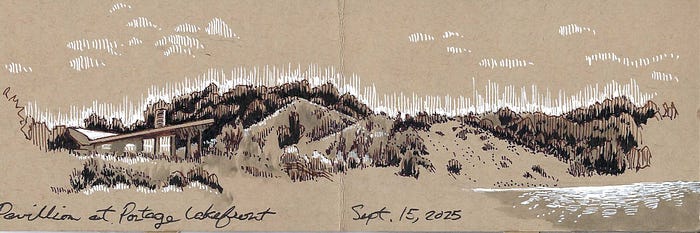
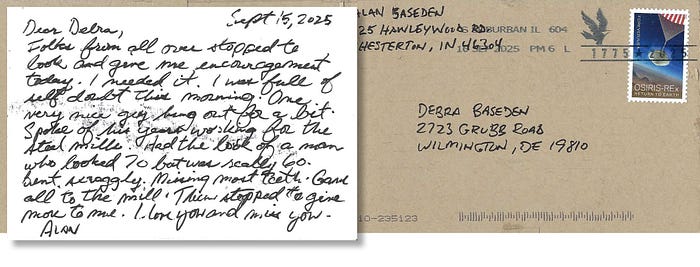
The sensitive architecture of the Portage Lakefront pavilion on the left tucks into the dunes, complementing and reflecting their flow. Beyond, the view transitions into a scene of ecological succession. You move back in time as you move inland, and you see the change in plant life from marram grass, to cottonwoods, to mature oaks.
What you don't see out of frame to my left is the hulking U.S. Steel plant that cleaves through the middle of Indiana Dunes National Park and roars all day.
Throughout the early 20th century, environmentalists fought industrial interests in an attempt to create a Sand Dunes National Park here. But by 1962, the metastasis of industrial growth had become unstoppable. Most of the land in this Central Dunes area had been sold. The sands were harvested, the diverse ecosystem was leveled.
The fight over the lakefront ended with legislation called the Kennedy Compromise. Dead treasures were amputated from what remained, creating both Indiana Dunes National Lakeshore and the Port of Indiana. This scrap of beach was later restored from a toxic dumping ground to give beach access to nearby townsfolk in 2008.
This is one of the reasons I was grateful to have Michele as my housemate. She was from the area and she understood the emotional weave of conflicting historical threads and the patterns they produced. Coincidentally, she was a former chemical engineer who had interned for Dupont in Delaware in her college days. So she understood my background a bit too.
After my earlier Mount Baldy hike, I grumbled to her over a plate of spaghetti about the local industries and their impact on this irreplaceable gem. She explained the pride in the community toward the steel industry and its role in building 20th century America. She put it into perspective for me when she likened it to the feelings Delawareans have for Dupont. They too have been accused of environmental damage. But watch what you say about the chemical titan when you're on a barstool at Stanley's Tavern.
As for the dunes, she didn't see these particular ones being as special as I did. She was there more for the plants. "There are many more dunes up the coast" she explained, "you should take a drive up there. It's quite beautiful."
Fair enough. My view of this ecosystem was limited to the tunnel-vision of a 24 square mile sliver. I liked the idea of expanding my vista and decided I would take a day at the end of my residency and do just that.
West Beach: Getting Answers
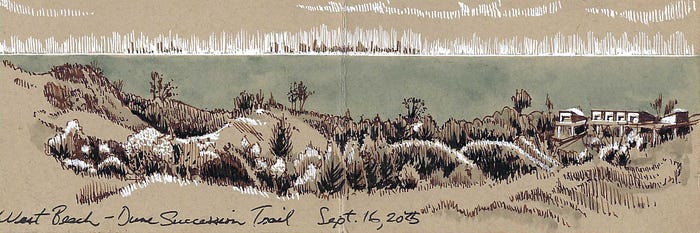
Indiana Dunes stretches across the southernmost shores of the banana-shaped Lake Michigan. On clear days like this one you can see the Chicago skyline 25 miles up the western coast, in the middle of this drawing.
The parking lot which is out of view to the left sits where a dune was mined and leveled. This prodded my curiosity and natural optimism. About how long it would take a destroyed dune to return?
According to the U.S. Geological Survey, the older inland dunes, like the one I was on top of for this drawing, began to form about 10,000 years ago. This happened after the glaciers melted away at the end of the last ice age, forming the Great Lakes. The younger dunes that I was looking at, closer to the shore, began forming about 5,900 years ago. Murdered dunes stay murdered for an awfully long time.
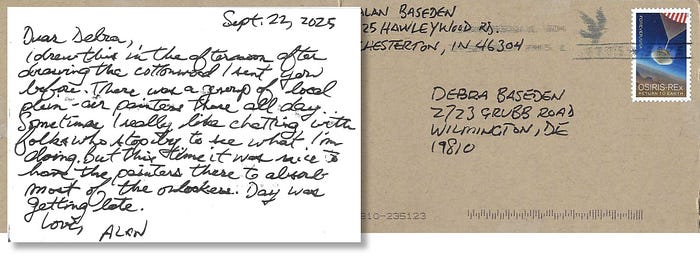
The following day started with a call-in to an appointment with Dr. Rastogi. Gallbladder cancer is aggressive, silent, and deadly. Most people only find out they have it in time to make their peace with God. She was living with this for nearly two years now and I was grateful to her for not dying.
I sat on the edge of my wobbly twin-sized bed on Hawleywood Road jotting notes as we discussed the results of Debra's most recent cancer tests with Dr. Rastogi — perhaps the most remarkably kind and comforting woman I have ever met. Her bedside manner made once-terrifying visits almost soothing. In a way I could have never imagined two years ago, I put the results behind me and got to work.
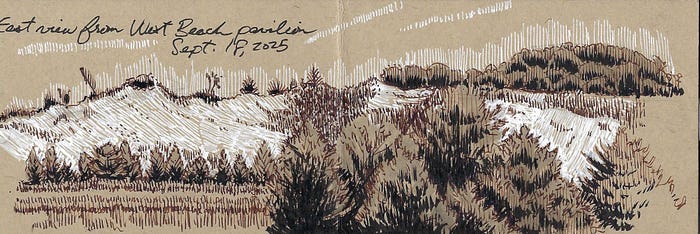
I journeyed back to West Beach for another sketch. The drawing I had done that day is the east view from the pavilion that you see on the right edge of the previous drawing. The flat part on the left is a blowout where the wind has excavated the dune to reveal the water below. Behind it, and out of view to the left, is Lake Michigan. Out of frame to the right is oak savanna.
The savanna is covered in rough blazing stars — a purple flower speckled at that time of year by migrating monarch butterflies. I wish I could have captured a sketch of the colorful creatures, but they are much too skittish. My mother was a master gardener and a great advocate for these butterflies. She grew milkweed in her garden to nurture them. I felt her presence very close that day and I needed it.
Debra and I spoke again at bedtime as we did every night of my stay. We realized we had both had the same experience after her visit with her oncologist. We had both erased the visit out of our heads and buried ourselves in the tasks of the day. Only then when we were together on the phone again were we able to process Dr. Rastogi's thunderbolt.